Best Language Learning Apps: 8 Apps Compared and Ranked
The Language Research Desk
As an Amazon Associate we may earn a commission from qualifying purchases made through links on this page, at no extra cost to you.
This page is the ranked comparison: eight apps, pricing, and which plan fits which goal. The shorter “what each tool is for” stack — without a numbered ranking — is Best Language Learning Apps: What Works and What Does Not. We keep both URLs so a ranking query and a method query do not collapse into one page.
The Language Research Desk does not run a 90-day lab and does not claim reviewers lived in each app for a quarter. The ranking below is a job-and-coverage list: what each product is built to teach, where it stops, and which plan is a different SKU. If a store page says “fluent in 15 minutes a day,” treat that as marketing. Category I languages such as Spanish still sit near 600–750 classroom hours on the FSI difficulty rankings.
This is not a sponsored ranking. No app paid for placement here.
How the desk ranked these apps
These are buying criteria, not a scored lab:
- Teaching method quality --- Does the app explain concepts clearly and build skills progressively?
- Skill coverage --- Does it address reading, writing, listening, and speaking, or just one or two?
- Retention job --- Is there a real review schedule, or only a quiz toy?
- Value for price --- Is the locked feature the job you will use daily, or ads/offline/a certificate?
- Ceiling --- Can you use this app past beginner without buying a second product for the same job?
Speech recognition is a pronunciation prompt, not a tutor. Live speech is best online language tutors or language exchange apps.
The 8 Best Language Learning Apps, Ranked
1. Babbel --- Best Structured Course for Beginners
Price: $7-14/month (depending on plan length) | Languages: 14 | Free tier: First lesson only
Babbel remains the gold standard for self-study courses in 2026. Every lesson is built by in-house linguists, and it shows. Grammar rules are explained in plain English before you practice them, conversation scenarios feel practical rather than contrived, and the review system uses spaced repetition to reinforce vocabulary at the right intervals.
The app teaches in themed modules --- ordering food, making small talk, navigating a city --- so the vocabulary you learn is immediately usable. Each lesson runs 10-20 minutes, which is long enough to learn something substantial but short enough to fit into a lunch break.
Where Babbel falls short: It covers 14 languages, which means no Norwegian, Dutch, or less-common options. The content caps out around B1 level (intermediate), so advanced learners will outgrow it. And there is no live conversation practice built in.
Best for: Serious beginners who want to understand grammar rules, not just memorize phrases. Adults who learn better with explanations than trial-and-error.
For a head-to-head breakdown of how Babbel stacks up against its closest competitors, read our Duolingo vs Babbel vs Rosetta Stone comparison.
2. Pimsleur --- Best for Listening and Speaking
Price: $15/month (subscription) or $120/level (purchase) | Languages: 51 | Free tier: First lesson free
Pimsleur is an audio-first method built around a concept called “graduated interval recall.” Each 30-minute lesson introduces new vocabulary and grammar through spoken dialogues, then prompts you to recall and produce phrases at increasing intervals. You listen, repeat, and respond aloud.
This approach builds two skills that most apps neglect: listening comprehension of natural-speed speech and the ability to formulate spoken responses without reading from a screen. After 30 lessons of Pimsleur Spanish, most learners can handle basic conversations at a level that surprises them.
Where Pimsleur falls short: No reading or writing practice at all. The pace is slow for quick learners. And at $15/month or $120 per level (5 levels for major languages), it is one of the more expensive options.
Best for: Commuters, auditory learners, and anyone who wants to prioritize speaking ability over reading. Works exceptionally well paired with a text-based app like Babbel.
Pimsleur Spanish Level 1 (CD Box Set) --- The physical CD version is useful for learners who prefer offline listening without a subscription. Check price on Amazon →
Listing check (The Language Research Desk): Confirm Level 1 Spanish, CD vs digital download, and whether the box is a current Pimsleur pressing or a marketplace reprint. The app subscription is a different product than this physical set.
3. Duolingo --- Best Free App for Daily Practice
Price: Free (with ads); Super: $7/month | Languages: 40+ | Free tier: Full course access
Duolingo’s strength has never been the depth of its teaching. It is the consistency engine. The streak system, XP leaderboards, and achievement badges create a feedback loop that gets millions of people to practice every single day. And daily consistency is the single most important factor in language learning.
The course content has improved over the past two years. Duolingo’s newer “path” format provides a more structured progression than the old skill tree, and the explanation cards that appear before some exercises are a welcome addition. For languages like Norwegian and Dutch, Duolingo’s community-built courses are among the best available on any platform.
Where Duolingo falls short: Grammar explanations remain thin. Many exercises teach translation rather than thinking in the target language. The gamification encourages easy reviews for XP over challenging new material. And the free tier now interrupts learning with full-screen ads.
Best for: Absolute beginners, casual learners, people who need external motivation to practice daily, and learners of less-common languages where other apps have limited offerings.
4. italki --- Best for Live Conversation Practice
Price: $8-30/lesson (varies by tutor) | Languages: 150+ | Free tier: No
italki is not an app in the traditional sense. It is a marketplace connecting you with language tutors and conversation partners worldwide. You book one-on-one video sessions with native speakers, either professional teachers (more structured, higher price) or community tutors (conversation-focused, lower price).
Nothing in the app world replaces the experience of speaking with a real person who corrects your mistakes in real time. Most learners who reach conversational fluency credit italki or similar tutoring as the turning point. Even one 30-minute session per week produces noticeable improvement within a month.
Where italki falls short: Tutor quality varies. You need to try a few before finding a good match. There is no curriculum unless the tutor provides one. And it requires scheduling, which adds friction compared to opening an app whenever you have five minutes.
Best for: Learners who have basic vocabulary (from apps or textbooks) and need to start speaking. The most effective supplement to any other learning method.
5. Busuu --- Best for Community Feedback
Price: Free (limited); Premium: $10/month; Premium Plus: $14/month | Languages: 14 | Free tier: Limited lessons
Busuu combines structured lessons similar to Babbel with a community correction feature where native speakers review your written and spoken exercises. This peer feedback adds a human element that pure algorithm-based apps lack.
The Premium Plus tier includes a “Study Plan” feature that adapts to your schedule and goals, and access to official McGraw-Hill certificates upon completing certain levels. The course content is solid if not spectacular.
Where Busuu falls short: The community feedback depends on active users. Response times vary. The course content is not as polished as Babbel’s. And the certificate value is limited outside of personal motivation.
Best for: Learners who want human feedback without the cost of private tutoring. Good mid-range option between Duolingo’s gamification and Babbel’s structure.
6. Rosetta Stone --- Best for Immersive Learners
Price: $12-15/month or ~$179 lifetime | Languages: 25 | Free tier: 3-day trial
Rosetta Stone teaches entirely in the target language with no English translations. You learn by matching words to images and building meaning through context. The method trains your brain to think directly in the new language rather than translating from English.
The subscription now includes live group tutoring sessions with native speakers, which addresses the biggest historical criticism of the platform. The TruAccent speech recognition technology provides detailed pronunciation feedback that remains the best in the industry.
Where Rosetta Stone falls short: The no-explanation approach is slow. Concepts that a grammar explanation could convey in 30 seconds take 15 minutes of contextual deduction. The image-based exercises can feel childish. And it is the most expensive monthly option.
Best for: Patient learners who want to avoid English crutches. Those who value pronunciation accuracy. People willing to invest more time per session.
7. Anki --- Best for Vocabulary Retention
Price: Free (desktop/Android); $25 one-time (iOS) | Languages: Any | Free tier: Fully free on desktop
Anki is a spaced repetition flashcard app. It is not pretty, it is not fun, and it has a steep learning curve. But for raw vocabulary acquisition and long-term retention, nothing else comes close. The algorithm schedules each card for review at the mathematically optimal interval, based on decades of memory research.
The real power of Anki is customization. You create your own cards (or download pre-made decks), add images and audio, and build a vocabulary system tailored to exactly what you are learning. Serious language learners and medical students swear by it.
Where Anki falls short: No grammar instruction, no speaking practice, no listening comprehension. The interface is utilitarian. Setting up effective cards takes time and skill. It is a supplement, not a standalone method.
For a deeper look at the science behind Anki’s algorithm, see our guide on spaced repetition and how it works. Which flashcard app fits which learner is on best flashcard apps for vocabulary.
Best for: Committed learners willing to invest setup time for maximum vocabulary retention. Pairs perfectly with any other method on this list.
8. Language Transfer --- Best Free Audio Course
Price: Completely free | Languages: 8 | Free tier: Everything is free
Language Transfer is a passion project by a polyglot teacher named Mihalis Eleftheriou. Each course is a recorded series of lessons where a real student learns the language in real time, guided by the teacher’s explanations. You listen, pause, and try to answer before the student does.
The teaching method focuses on patterns and logic rather than memorization. In the Spanish course, for example, you learn early that English words ending in “-tion” become “-cion” in Spanish, instantly giving you access to hundreds of words. The approach is clever, efficient, and genuinely engaging.
Where Language Transfer falls short: Only 8 languages available. No reading or writing practice. No spaced repetition or review system. The courses end at roughly A2 level.
Best for: Beginners on a zero budget. An excellent complement to Duolingo’s gamified approach --- Language Transfer explains the “why” that Duolingo skips.
The Best App Combinations
No single app covers all four language skills (reading, writing, listening, speaking). Here are proven combinations:
Budget stack (under $10/month):
- Duolingo (free) for daily vocabulary
- Language Transfer (free) for grammar understanding
- Anki (free) for retention
- HelloTalk (free) for text-based conversation
Serious learner stack ($15-25/month):
- Babbel ($7-13/month) for structured lessons
- Pimsleur ($15/month) for listening and speaking
- Anki (free) for vocabulary retention
- italki (pay per lesson) for weekly conversation
Speed stack (fastest progress, highest cost):
- Babbel for grammar foundation
- Pimsleur for audio skills
- italki (2-3 sessions/week) for speaking
- A good textbook for reference --- see our best language learning tools guide for recommendations
How to run the ranked stack (first six weeks)
Do not buy the whole table. One daily drill app plus one empty-job add-on is enough.
Weeks 1–2. Pick Babbel or Duolingo or Language Transfer. Fifteen to twenty minutes. Speak every new line aloud. Confirm the language exists on the paid app before you subscribe (Babbel: 14 languages; no Norwegian or Dutch).
Weeks 3–4. Keep that app. Add one of: Pimsleur if listening on a commute is empty; Anki if you are meeting words the app never reviews; a learner podcast from best podcasts to learn languages. Still no second phrase app.
Weeks 5–6. Book a trial tutor or a patient exchange partner if you can answer “what did you do today?” in short sentences. That is the speaking product. Super, Premium Plus, and lifetime deals are still optional.
Session shape for any of the eight:
- New material before review-for-points.
- Produce one unscripted sentence (write it or say it to a person).
- Stop at 20 minutes. A second app in the same sitting is usually the same job twice.
If you are still choosing the language, start with what is the easiest language for English speakers. Spanish-only free routines are on how to learn Spanish fast for free.
Skip-buy notes vs the ranking
| Tempting add-on | Desk reading |
|---|---|
| Duolingo Super + Babbel | Two beginner-phrase subscriptions. Pick one. |
| Pimsleur app + Pimsleur CD Level 1 | Same audio method, two SKUs. Confirm language, level, and CD vs download vs subscription. |
| Busuu Premium Plus + italki | Certificates are not correction. Pay Plus for community reviews or pay a tutor, not both in week 1. |
| Rosetta Stone lifetime + a tutor marketplace | Lifetime is a license. If you already want interruption, the cheaper experiment is monthly Rosetta or the tutor, not both prepaid. |
| Anki iOS + Memrise Pro + a “10,000 card” deck | One retention tool. Cap new cards. The iOS Anki app is not an Amazon box. |
| Headphones as a “complete system” | Study audio. Confirm model number. They do not teach grammar. |
Gear That Makes App-Based Learning Better
Good audio equipment makes a real difference when your learning depends on hearing pronunciation clearly:
-
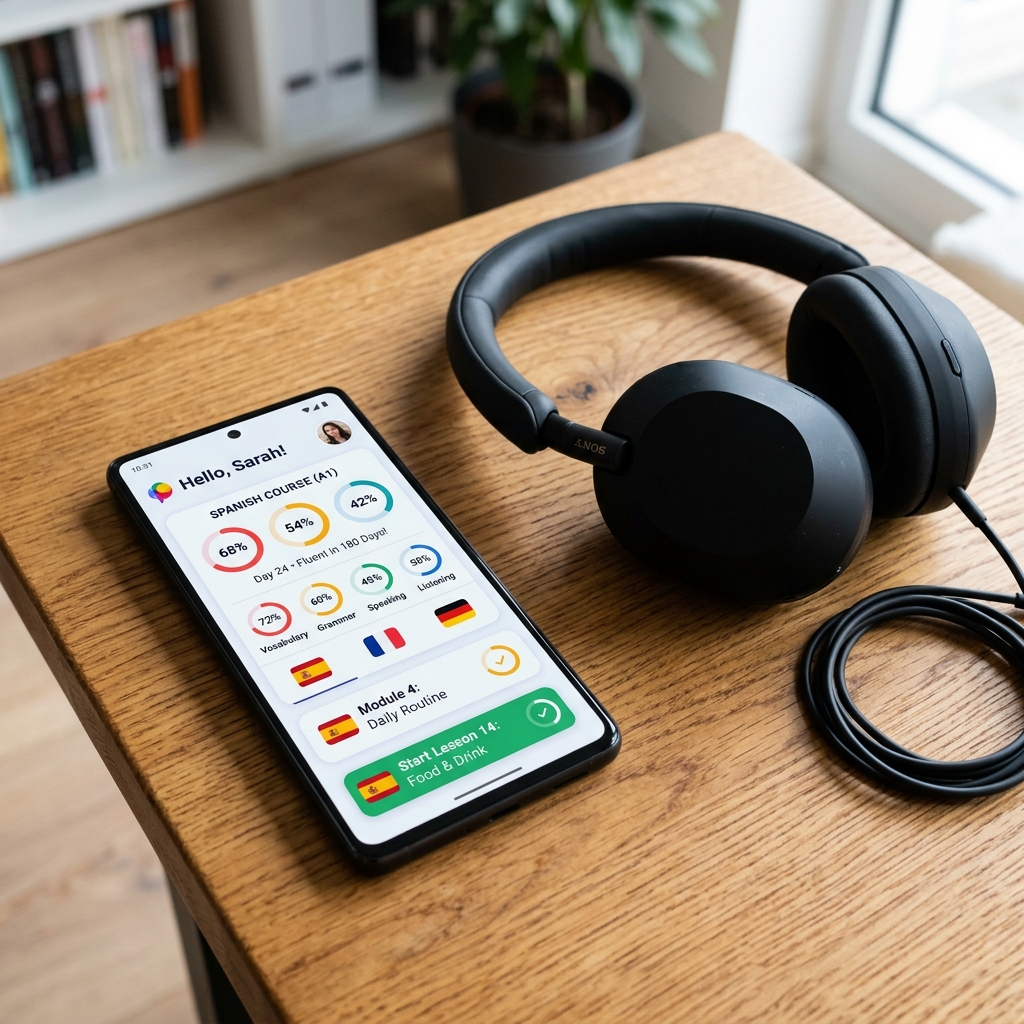
Sony WH-1000XM5 Wireless Headphones --- Active noise cancellation keeps you focused during Pimsleur lessons and italki sessions. The microphone quality is good enough for video tutoring calls.
-
Anker Soundcore Life Q30 Headphones --- A budget-friendly alternative with decent noise cancellation. Solid option if you want good audio without the Sony price tag.
Listing check (The Language Research Desk): Headphone generations change often. Check the model number on the Amazon page (WH-1000XM5 vs a newer XM line; Q30 vs a later Soundcore), seller, and return window. We are not scoring these as products in schema — they are study-session audio, not a ranked offer.
How to Choose Your First App
If you have never learned a language before, start with Duolingo or Babbel for the first month to build basic vocabulary and get a feel for the language. Within 4-6 weeks, add a second tool that addresses a different skill --- Pimsleur for listening, italki for speaking, or Anki for retention. When you are ready for paid conversation, our online language tutors comparison covers italki, Preply, and the rest.
The specific app matters less than consistency. Fifteen minutes every day with a mediocre app beats an hour once a week with the best app. Pick one, start today, and adjust your toolkit as you learn what works for your brain.
For context on which languages pair best with which apps, our easiest languages for English speakers guide breaks down the best starting points by language. The three-app head-to-head stays on Duolingo vs Babbel vs Rosetta Stone. The shorter job list stays on what works and what does not.
Frequently Asked Questions
What is the best language learning app in 2026? ▼
There is no single best app for everyone. Babbel is the best structured course for serious beginners. Duolingo is the best free option for building a daily habit. Pimsleur is the best for developing listening and speaking skills. italki is the best for conversation practice with real tutors. Most successful learners combine 2-3 tools rather than relying on one app.
Are free language learning apps good enough to reach fluency? ▼
Free apps like Duolingo and Language Transfer can build a solid foundation in vocabulary and grammar, but reaching conversational fluency typically requires adding conversation practice, reading, and listening to native content. You can absolutely learn a language for free, but it takes more effort to assemble the right combination of free resources.
How much should I spend on language learning apps per month? ▼
A reasonable budget is $10-20 per month. One paid app (Babbel at $7-13/month or Pimsleur at $15/month) plus occasional italki lessons ($8-15 per session) covers most needs. Many learners start with free tools and add paid resources only when they hit limitations.
Should I use multiple language learning apps at the same time? ▼
Yes, but with purpose. Each app serves a different function. Use one app for daily vocabulary and grammar practice, a separate tool for speaking practice, and native content for listening. Using two apps that do the same thing (like Duolingo and Babbel simultaneously) is usually redundant.
Which language learning app has the best speech recognition? ▼
Rosetta Stone's TruAccent technology is generally considered the most accurate for pronunciation feedback. ELSA Speak is excellent specifically for English pronunciation. Babbel's speech recognition is solid for structured lessons. Duolingo's speech recognition is the least precise of the major apps.
Did The Language Research Desk test each app for 90 days? ▼
No. The desk does not run a test fleet or a timed lab. Rankings below are listing checks against published course structure, pricing pages, and which skill each app actually covers. Treat store copy that says “fluent in 15 minutes a day” as marketing.
Which paid app should I skip in the first month? ▼
Skip a second phrase app, a lifetime deal you have not trialled, and Pimsleur plus Babbel together if both would only teach tourist lines. Pick one structured daily tool. Add Anki when you have words those apps never taught. Add italki or an exchange app when you can form basic sentences.
We research and compile information about language learning from linguistic studies, FSI data, and language learning communities.
Related reading
 Book Reviews
Best Books to Learn Spanish for Beginners
The best Spanish textbooks, workbooks, and readers for beginners in 2026. Reviewed by learning style with honest pros and cons.
 Book Reviews
Best Books to Learn French by Self Study
The best French textbooks, workbooks, and readers for self-study. Reviewed with honest pros, cons, and which learning style each fits.
 App Reviews
The 7 Best Language Exchange Apps for Real Conversation Practice in 2026
Desk notes on HelloTalk, Tandem, italki community, and other exchange apps — matching jobs, free-tier limits, and when not to pay Pro.